
Media
About Helen Parker-Drabble
Media Resources
Welcome to the media resource centre for Helen Parker-Drabble, author of Yet: A Story of Triumph Over Childhood Separation, Trauma, and Disability and A Victorian’s Inheritance, and creator of the geneatherapy methodology.
This media page includes author bio, interview topics, press images and contact details for journalists and podcasters covering intergenerational trauma and family history.
Can’t find what you need? Contact Helen directly.
Quick Navigation
- About Helen Parker-Drabble
- Current Books
- Downloadable Media Kits
- Interview & Q&A Resources
- Speaking Engagements
- High-Resolution Images
- Publicity Contact
About Helen Parker-Drabble
Professional Biography (Long Form)
Helen Parker-Drabble recovers ordinary lives from the traces they leave behind: a shy village boy who nonetheless would not take off his cap to the Duke of Bedford’s man, and who spent decades homesteading on the Canadian prairies; a boy of two and a half admitted to a Sheffield hospital in 1937, who was not discharged for two years and whose parents could visit only one at a time, for an hour a month.
An author, speaker, independent scholar, and former counsellor, she reconstructs lives from census returns, civil registration, and family papers. She reads that evidence in the light of what psychology has established about how people are shaped by what happens to them, and how the effects reach the generations that follow, so that behaviour a family has long put down to a difficult character can be understood as the mark of what that person lived through.
She writes under the series Who Do I Think You Were?®, published by Animi Press. Her books include A Victorian’s Inheritance (2020) and ‘Yet’: A Story of Triumph over Childhood Separation, Trauma, and Disability (2025), which was Runner-up for the CILIP LSG Alan Ball Award 2025 (Best Hardcopy Publication) and Silver Winner in the NFAA Book Awards 2026 (Biography and Memoir). Her next work, the three-volume Mary: A Victorian Life Recovered, opened with A Victorian Recipe Book in Facsimile (2024, second edition 2027) and will be completed in 2027.
Her peer-reviewed writing has appeared in Genealogy and The Local Historian. Her wider work has been featured in Who Do You Think You Are? magazine, Family Tree Magazine, and Discover Your Ancestors, and by History & Policy at the Institute of Historical Research. She lives and works in Bristol.
Professional Biography (Short Form)
Helen Parker-Drabble recovers ordinary lives from the traces they leave behind. An author, speaker, independent scholar, and former counsellor, she reads historical evidence in the light of what psychology has established about how people are shaped by what happens to them, and how the effects reach the generations that follow. She writes under the series Who Do I Think You Were?®. Her most recent book, ‘Yet’: A Story of Triumph over Childhood Separation, Trauma, and Disability, was Runner-up for the CILIP LSG Alan Ball Award 2025 (Best Hardcopy Publication) and Silver Winner in the NFAA Book Awards 2026 (Biography and Memoir). Her peer-reviewed writing has appeared in Genealogy and The Local Historian. She lives in Bristol.
One-Line Biography
Author and speaker. Recovers ordinary lives from the traces they leave behind. Reads family history through psychology. Bristol.
Key Topics and Expertise
- Reading family history records for the human experience behind them
- Psychological inheritance: what families hand on besides money and possessions
- Childhood separation and long-stay hospitalisation in Britain, 1930s to 1950s
- Bovine tuberculosis and its impact on British families
- Attachment and adverse childhood experience as tools for historical research
- Emotional distance and estrangement across generations
- Victorian working-class life: poverty, alcoholism, and class
- Victorian women’s lives: abandonment, legal constraint, and survival without divorce
- Household manuscripts and recipe books as historical evidence
- Writing and publishing family history narratives
Current Books
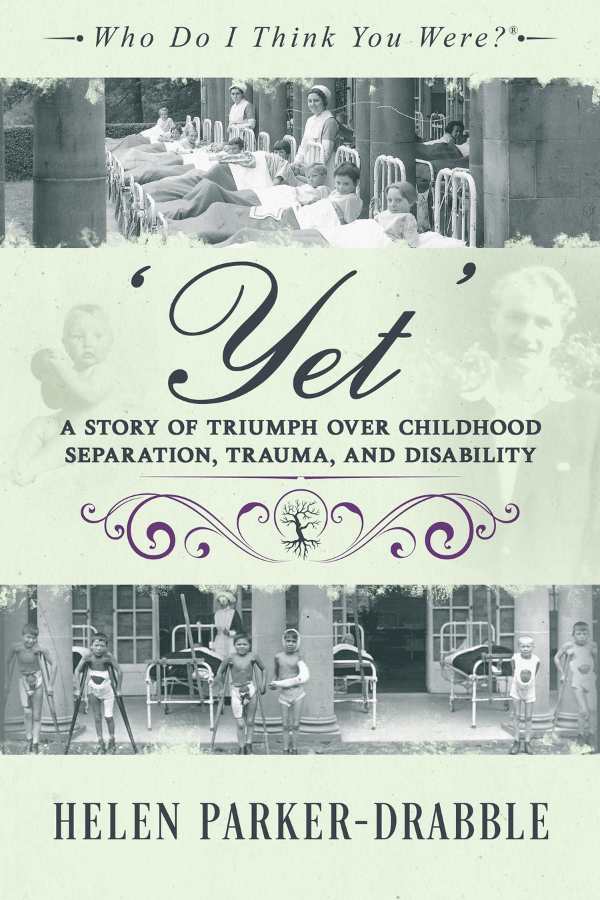
‘Yet’: A Story of Triumph Over Childhood Separation, Trauma, and Disability (2025)
Who Do I Think You Were?® Animi Press · 31 October 2025 · 322 pages
Paperback 978-1-9162466-8-3 · Large Print 978-1-0684013-0-5 · Hardback 978-1-9162466-9-0 · Special Edition Hardback 978-1-0684013-1-2 · eBook 978-1-9162466-7-6
Runner-up, CILIP LSG Alan Ball Award 2025 (Best Hardcopy Publication). Silver Winner, NFAA Book Awards 2026 (Biography and Memoir).
In 1937 Harry Drabble, aged two and a half, was admitted to Sheffield’s King Edward VII Memorial Hospital for Crippled Children with bovine tuberculosis contracted from unpasteurised milk. He was not discharged for two years, and his parents could visit only one at a time, for an hour a month. He spent seven years of his childhood as an inpatient, immobilised in plaster, and was written off as a boy who would never work, marry, or live an ordinary life.
He became an accountant and a senior manager, and taught music for thirty-five years. His phrase was ‘I can’t… yet’.
Written with his daughter, the book sets Harry’s own account against hospital and archival records, and reads both in the light of what is established about separation and attachment. It is a rare first-hand account of long-stay childhood hospitalisation in Britain, with 161 photographs, 299 endnotes, and eighteen discussion questions for reading groups.
Praise for ‘Yet’
‘A mirror image of what I experienced. I hung on every word. I was back in the hospital with him.’
— Bob Shaw, former patient, Children’s Hospital Birmingham
‘The unknown chapter of my husband’s life has now been written. I am more grateful than I can say. It’s been a solemn but liberating experience.’
— Mary
‘A deeply moving and beautifully written book. Helen captures that world with honesty, warmth, and compassion.’
— Neil Anderson‘Well written and beautifully illustrated, this story gives us important messages about children who require recurrent hospital admissions.’ — Dr Michael Whitfield, British Society for the History of Medicine
‘Despite assumptions that his disabilities would limit education, work, and marriage, Harry overcame stigma to build a fulfilling life.’ — Kevin Brown, former chairman of the London Museums of Health and Medicine
Available: Buy now | Read Sample
A Victorian’s Inheritance (2020)
Series: Who Do I Think You Were?® · Animi Press · 328 pages
Paperback 978-1-9162466-1-4 · Large Print 978-1-9162466-3-8 · Hardback 978-1-9162466-2-1 · eBook 978-1-9162466-0-7
Walter Parker grew up in Thorney, the Duke of Bedford’s model village in Cambridgeshire, in a household shaped by bereavement, poverty, and his mother’s drinking. One refusal, to doff his cap to the Duke’s estate manager, altered the family’s course.
The book reconstructs that world from archival sources and family testimony, and asks what Walter inherited from it, and what he handed on. It is about addiction, grief, and emotional distance in a Victorian working-class family, and about how those patterns persist. 161 photographs and documents, extensive endnotes, and book club questions.
‘Helen Parker-Drabble takes her analysis even further, going beyond discussion of social and historical context to draw on psychological theory and research as a way of examining the motives and feelings of her ancestors.’
— Emeritus Professor Susan Moore, co-author of The Psychology of Family History: Exploring Our Genealogy
‘If you find yourself opening any cupboards this week, be careful. There could be a skeleton inside. She pulls no punches on awkward subjects that crop up in her own family, including alcoholism, plus the story of her grandfather, who changed the course of family history when he refused to doff his cap to the local lord of the manor’s estate manager.’
— Graham Carter, columnist, This Is Wiltshire
‘Not only do we get the facts, we also get the benefit of the author’s skills as a counsellor and her knowledge of psychology; she shows us that anxiety, depression and addiction were as much part of our ancestors’ lives and affected the whole family just as they do today.’
— Delyth, UK
Available: Buy Now | Download Sample
The Mary Project: A Three-Volume Box Set (In Development)
In 1860 a twenty-four-year-old Sheffield woman opened a blank notebook. The previous September her husband had given their son, not yet two, to his own mother to raise, and sailed for New Zealand. Their daughter was born a week after the ship left. Mary Allott was not a widow, and the law would not let her stop being a wife. She petitioned for divorce in 1873; the case was dismissed in 1875. She kept the notebook for fifty-two years, and it is one of the few surviving traces of the life she built afterwards.
Book One. A Victorian Recipe Book in Facsimile: Mary Allott’s Handwritten Book of Household Receipts (2024, second edition 2027).
Previously published as A Facsimile Reproduction of a Victorian Recipe Book: A Handwritten Book of Family Receipts Started by Mrs C. A. Allott of Sheffield, (England), 1860. Every page as it survives: handwriting, crossings-out, insertions, stains, and wear. The second edition adds the loose papers tucked between the pages and never bound in.
Book Two. Neither Wife Nor Widow: The Life of an Abandoned Wife in Victorian England (in progress).
The biography: the Sheffield years, the divorce court in 1875, the move to Chesterfield, and the marriage at seventy that convention said should never have happened. Built from parish registers, censuses, court records, and the recipe book itself, where the names beside the recipes trace the women who kept her afloat.
Book Three. Interpreting Mary’s Recipe Book: Cooking, Ingredients, and Victorian Domestic Life (in progress).
Every entry transcribed and annotated, set against the printed cookery of the day. Over 280 recipes and household entries, more than seventy named contributors, all women. It reads the manuscript for the global trade behind everyday ingredients, the chemistry of the Victorian kitchen, and the seasonal round of preserving and foraging. Later keepers added their own: a magazine cutting from 1928, a Christmas pudding pencilled on a diary leaf for 23 December 1938.
The facsimile preserves her voice, the biography restores her life, the companion situates her world.
Downloadable Media Kits
‘Yet’ Media Resources
- ‘Yet’ Book Cover (High Resolution) — JPEG, 300dpi
- ‘Yet’ Summary Sheet — PDF
- ‘Yet’ Sample Chapters — PDF
- Book Club Discussion Questions — PDF
A Victorian’s Inheritance Media Resources
- A Victorian’s Inheritance Book Cover
- Sample Chapters — PDF
- Media Sheet — PDF (key facts, quotes, contact info)

General Author Resources
- Author Photographs — PDF (high-resolution professional headshots)
- Contact Information Sheet — PDF
Helen Parker-Drabble media Interview & Q&A Resources
Pre-Written Interview
Available Format: Full Interview PDF | Text Below
Sample Interview Questions & Answers
Q: What is psychological inheritance?
A: Psychological inheritance refers to the inherited traits, reactions, patterns of behaviour, and our take on life which are passed down through the generations and persist over time. We carry them with us, from situation to situation. It can be something positive or negative—patterns of anger, trauma, fear, or dissociation, but also optimism, resilience, gratitude, kindness, and the capacity to love. This is what’s meant by ‘epigenetics’—the idea that our lived experience can affect our children and grandchildren.
Q: Why did you write ‘Yet’?
A: Yet is my father’s story, but it’s also the story of hundreds of thousands of British children who were separated from their families for months or years during the 1930s–1950s due to tuberculosis, polio, evacuation, and other conditions. These children grew up carrying patterns of emotional distance and hypervigilance that affected their relationships with their own children. Understanding these patterns helps families make sense of inherited emotional distance and break cycles that no longer serve them.
Q: Who should read your books?
A: Anyone interested in family history, social history, psychology, or understanding intergenerational patterns in their own families. Genealogists will find practical frameworks for understanding ancestors beyond dates and places. Adult children struggling to understand emotionally distant parents may find validation and answers. And readers interested in British medical and social history will discover forgotten chapters that shaped millions of families.
Suggested Interview Topics
- How childhood separation trauma affected British families (1930s–1950s)
- Understanding psychological inheritance and epigenetics
- Breaking cycles of intergenerational trauma
- The forgotten history of bovine tuberculosis in Britain
- Victorian family life and psychological inheritance
- How family history builds resilience and mental health
- Writing your own family history: where to start
- The power of ‘yet’: growth mindset before it had a name
- Collaborating with parents on memoir projects
Audio/Video Interview Guidelines
- Helen is available for in-person interviews (Bristol, England area), phone, Zoom, or pre-recorded formats
- Lead time preferred: 2 weeks minimum for scheduling
- Typical interview length: 20–60 minutes depending on format
- Helen can provide historical photographs and documents for visual media
- B-roll footage available upon request
To arrange an interview: Contact Helen
Speaking
Helen speaks to family history societies, U3As, WIs, and literary festivals, online worldwide and in person across South West England. Current talks, formats, fees, and forthcoming engagements are on the Talks page.
High-Resolution Images
Author Photographs
Professional phots of Helen are available at the bottom of this page.
Book Covers
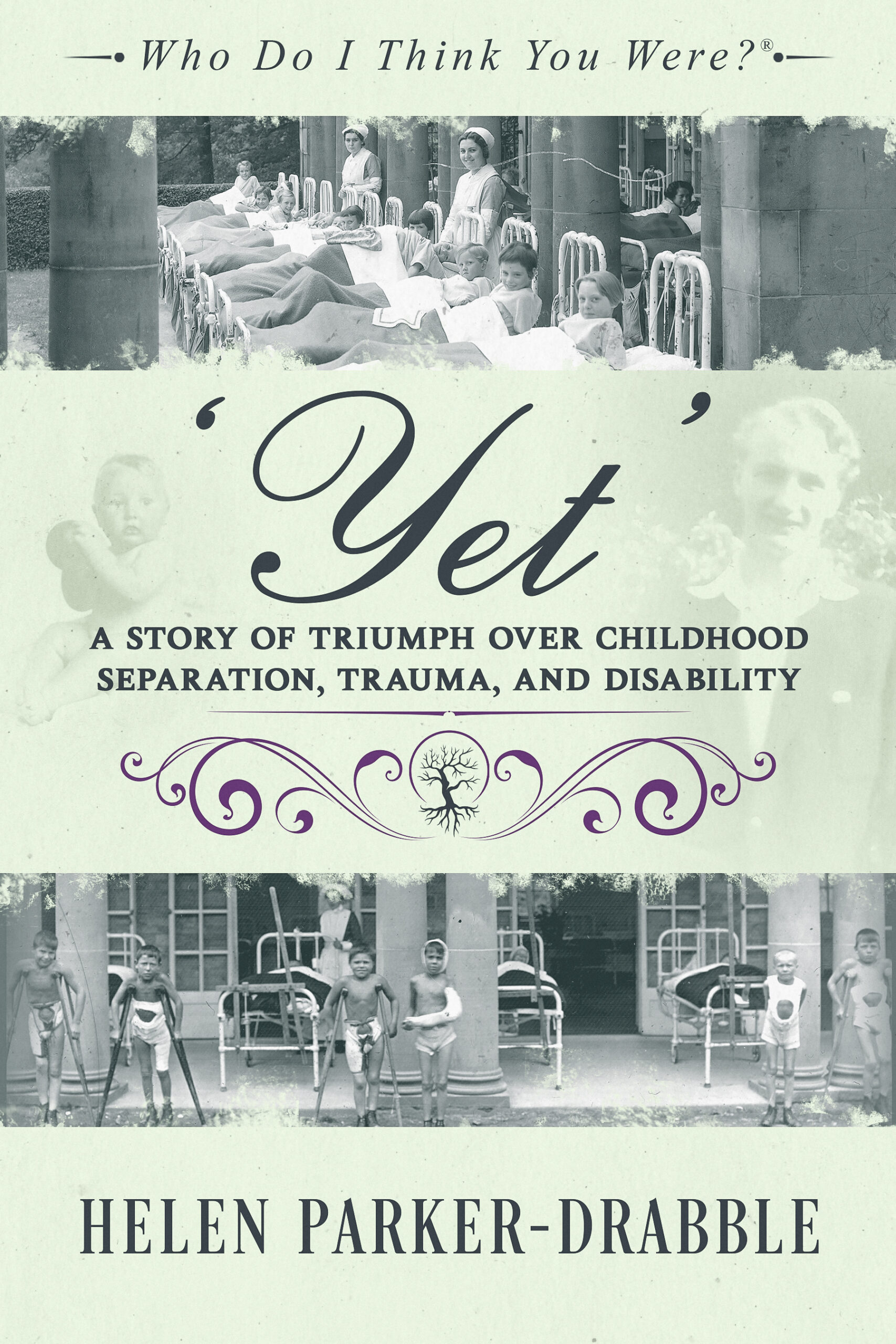
- Yet: A Story of Triumph — High-resolution cover (300dpi) — Download JPEG
- A Victorian’s Inheritance — High-resolution cover (300dpi) — Download JPEG
- Victorian Recipe Book — High-resolution cover (300dpi) — Download JPEG

Brand Assets
- Helen Parker-Drabble logo (tree design) — Multiple formats
- Who Do I Think You Were?® series branding
- Social media graphics
Image Usage: All author and book images are available for editorial use in connection with coverage of Helen Parker-Drabble and her books. Please credit as ‘Photo courtesy of Helen Parker-Drabble’ or as specified in download package.
Publicity Contact
For all media enquiries, interview requests, speaking engagements, and review copies:
Helen Parker-Drabble
Author | Speaker | Former counsellor
Bristol, England, United Kingdom
Email: Contact
Website: helenparkerdrabble.com
Connect on Social Media
- LinkedIn: Helen Parker-Drabble
- Facebook: @FactualTales
- Bluesky: @helenpdrabble
- Twitter/X: @HelenPDrabble
Media Response Time
Helen typically responds to media enquiries within 48 hours. For urgent requests, please indicate ‘URGENT’ in your subject line.
Review Copies
Digital and physical review copies available upon request for legitimate media outlets, bloggers with established audiences, podcasters, and book clubs. Please include:
- Publication/podcast/blog name and URL
- Audience size and demographics
- Intended publication/air date
- Format preference (digital/physical)
Frequently Asked Questions
About Helen’s Work
Q: Is Helen available for podcast interviews?
A: Yes! Helen regularly appears on podcasts covering family history, psychology, social history, and memoir. Contact via the form above to discuss scheduling.
Q: Can Helen speak at virtual events?
A: Absolutely. Please email helen@helenparkerdrabble.com
Additional Resources
Articles & Blog Posts
Read Helen’s in-depth articles on geneatherapy, intergenerational trauma, Victorian social history, and family estrangement: Visit the Blog
Sample Topics Include:
- Reading family history records for the human experience behind them
- Psychological inheritance: what families hand on besides money and possessions
- Childhood separation and long-stay hospitalisation in Britain, 1930s to 1950s
- Bovine tuberculosis and its impact on British families
- Attachment and adverse childhood experience as tools for historical research
- Emotional distance and estrangement across generations
- Victorian working-class life: poverty, alcoholism, and class
- Victorian women’s lives: abandonment, legal constraint, and survival without divorce
- Household manuscripts and recipe books as historical evidence
- Writing and publishing family history narratives
Newsletter
Join 460+ readers receiving geneatherapy insights, historical research, and psychological perspectives on family history. Subscribers receive:
- First 2 chapters of Yet (instant access)
- 10% discount code for all books
- Exclusive articles and research findings
- Early access to new releases
Last Updated: September 2026
All content © Helen Parker-Drabble. Author photographs, book covers, and biographical information available for editorial use in connection with coverage of Helen Parker-Drabble and her books.
Historical photographs subject to individual copyright restrictions as noted.
Author Photo Gallery


Brand Identity
